Football looks crazy complicated.
All those players. The constant stopping. The weird names for things.
I get it. Everyone feels lost at first.
But here’s the truth: NFL rules for beginners aren’t that hard. You just need someone to explain them in plain English. No fancy terms. No confusing jargon.
This guide ranks the rules of football for beginners from easiest to hardest. Start at the top. Work your way down. Each rule builds on the last one.
Some people grab an NFL rules for beginners PDF and try to memorize everything at once. That’s backwards. Learn the easy stuff first. The hard stuff makes more sense later.
Contents
- 1 NFL Rules for Beginners
- 1.1 Rule #1: The Field (Easiest to Understand)
- 1.2 Rule #2: The Players (Still Pretty Easy)
- 1.3 Rule #3: The Run Play (Getting Simple)
- 1.4 Rule #4: The Pass Play (Little Harder)
- 1.5 Rule #5: The Downs System (This Gets Tricky)
- 1.6 Yardage Rules Table
- 1.7 Rule #6: Scoring (Very Important)
- 1.8 Rule #7: Turnovers (Game Changers)
- 1.9 Rule #8: Special Teams (Kicks and Punts)
- 1.10 Rule #9: NFL Clock Rules Under 2 Minutes (Advanced Stuff)
- 1.11 How to Watch and Understand Football?
- 1.12 NFL Rules for Players
- 1.13 Simple Summary: You’re Ready to Watch
- 1.14 References and Sources
NFL Rules for Beginners
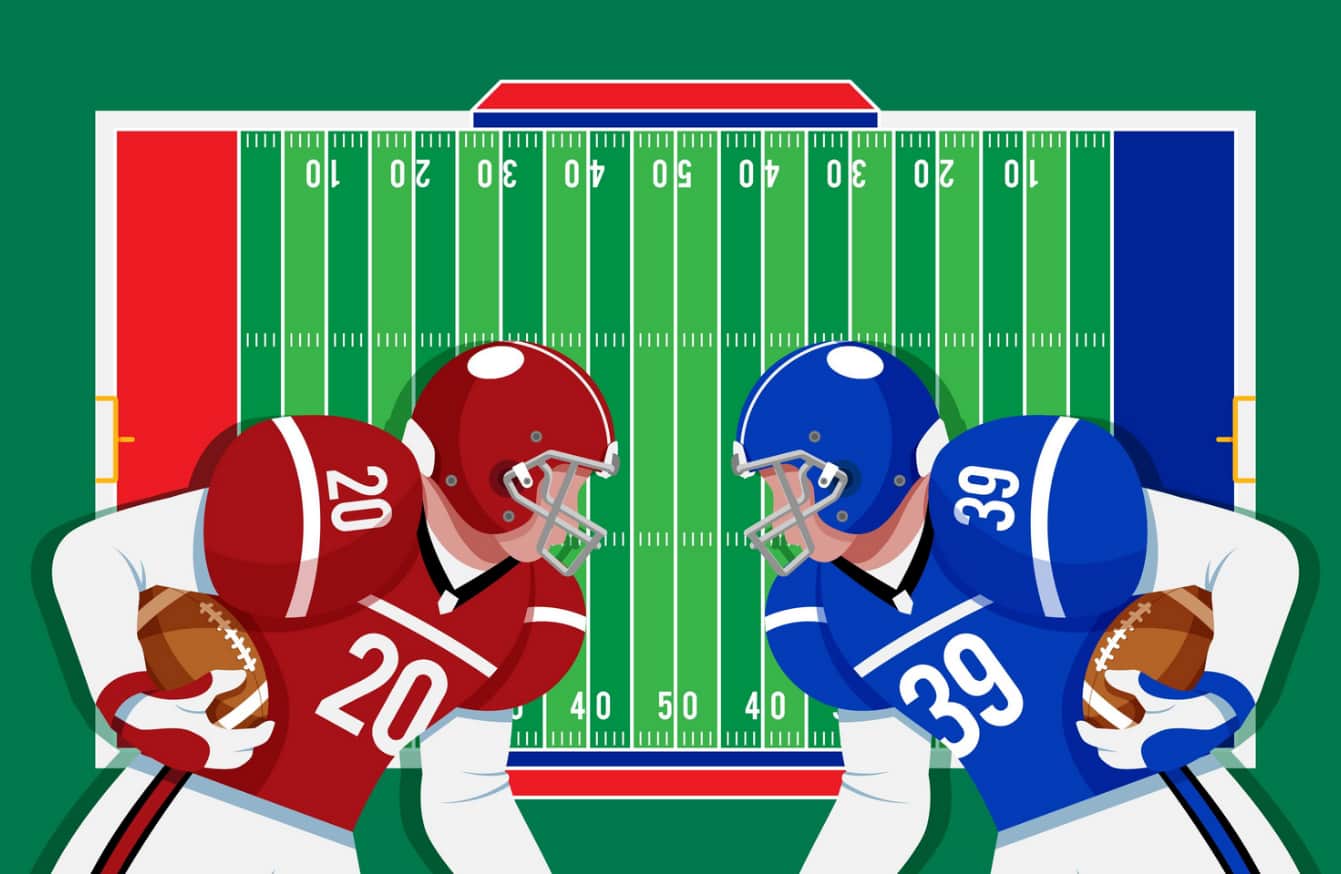
Let’s start with the simplest rule: the field itself.
Rule #1: The Field (Easiest to Understand)
The field is just a big rectangle with lines on it.
That’s it.
Field Layout Table
| Part | Size | What It Does |
|---|---|---|
| Length | 100 yards | Main playing area |
| Width | 53.3 yards | Sideline to sideline |
| End Zones | 10 yards each | Where points happen |
| Goal Posts | 18.5 feet wide | For kicking |
| Yard Lines | Every 5 yards | Track progress |
The white lines:
They’re numbered. Start at 0, go to 50, then back to 0. The 50-yard line sits in the middle.
End zones:
The painted areas are at each end. Get the ball there, and you score.
Goal posts:
The big yellow posts. Kick the ball through them for points.
Did you know? The field is exactly 1.32 acres in total size, including the end zones.
Rule #2: The Players (Still Pretty Easy)
Each team puts 11 players on the field. Always 11. Never more. Nevertheless.
One team has the ball (offense). The other team tries to stop them (defense).
Basics of Football Positions
Here’s your quick guide to the basics of football positions:
Offense (has the ball):
| Position | How Many | What They Do |
|---|---|---|
| Quarterback | 1 | Throws the ball |
| Running Back | 1-2 | Runs with the ball |
| Wide Receiver | 2-4 | Catches passes |
| Tight End | 1-2 | Blocks and catches |
| Offensive Line | 5 | Protects everyone |
Defense (stops the ball):
| Position | How Many | What They Do |
|---|---|---|
| Defensive Line | 3-4 | Rushes the QB |
| Linebacker | 3-4 | Tackles runners |
| Cornerback | 2 | Covers receivers |
| Safety | 2 | Defends deep passes |
You don’t need to memorize every position. Just know that 11 guys try to score and 11 guys try to stop them.
Did you know? NFL rosters have 53 total players, but only 46 can dress for each game.
Rule #3: The Run Play (Getting Simple)
Running is the most basic way to move the ball.
How it works:
Quarterback gets the ball. Hands it to a running back. Running back runs forward until someone tackles him.
That’s a run play.
When teams run:
- Need just a few yards
- Want to control the clock
- Weather is bad
- Already winning
Average run: About 4 yards.
Good run: 7-10 yards.
Great run: 15+ yards.
Running is safe. You can’t throw an interception when running. The ball rarely gets fumbled.
Did you know? The average NFL team runs the ball about 27 times per game.
Rule #4: The Pass Play (Little Harder)
Passing is riskier but gets you more yards faster.
How it works:
QB drops back. Receivers run routes. QB throws the ball. Receiver tries to catch it.
Three things can happen:
- Receiver catches it (complete pass)
- Ball hits the ground (incomplete pass)
- Defender catches it (interception – bad!)
When teams pass:
- Need lots of yards
- Playing from behind
- Third down situations
- Two-minute drill
Average pass: About 7 yards.
Good pass: 12-15 yards.
Great pass: 25+ yards.
Did you know? Top QBs complete about 65-68% of their passes.
Rule #5: The Downs System (This Gets Tricky)
Here’s where NFL rules for beginners start getting complicated.
The basic rule:
You get 4 tries (downs) to move the ball 10 yards forward.
If you succeed: Get 4 new tries from your new spot.
If you fail: Other team gets the ball.
Yardage Rules Table
| Down | Typical Yardage | What Usually Happens |
|---|---|---|
| 1st Down | 10 to go | Run or safe pass |
| 2nd Down | 3-7 to go | Mix of both |
| 3rd Down | Any | Critical conversion attempt |
| 4th Down | Any | Punt or field goal |
Example:
Your team starts at their 20-yard line. They need to reach the 30-yard line (10 yards away).
First play: Run for 3 yards. Now it’s 2nd down and 7 yards to go.
Second play: Pass for 8 yards. You made it past the 30! First down. Reset to 1st and 10.
The yellow line on TV:
That’s the first-down marker. It’s not real. Computers add it for viewers.
Did you know? NFL teams convert about 40% of third-down attempts on average.
Rule #6: Scoring (Very Important)
Points win games. Here are all the ways to score.
Complete Scoring Table
| Score Type | Points | How It Happens |
|---|---|---|
| Touchdown | 6 | Ball crosses goal line into end zone |
| Extra Point | 1 | Kick after touchdown |
| Two-Point Try | 2 | Run/pass after touchdown |
| Field Goal | 3 | Kick through posts |
| Safety | 2 | Tackle in own end zone |
Touchdown (6 points):
Get the ball into the end zone. Run it in. Catch it there. Doesn’t matter how. Six points.
Extra point (1 point):
After a touchdown, kick the ball through the posts. Almost automatic. Adds one point.
Two-point conversion (2 points):
Instead of kicking, try running or passing into the end zone again. Harder but worth double.
Field goal (3 points):
Kick the ball through the posts from anywhere on the field. Usually done on 4th down when you can’t score a touchdown.
Safety (2 points):
Rare. Tackle the offense in their own end zone. Defense gets 2 points AND the ball back.
Did you know? The average NFL game has a combined score of about 47 points.
Rule #7: Turnovers (Game Changers)
Turnovers flip games. They’re huge momentum swings.
Fumble:
Ball carrier drops the ball. Anyone can grab it. Whoever recovers it gets possession.
Interception:
Defender catches a pass meant for the offense. Defense becomes offense instantly. Can run it back for a touchdown.
Why turnovers matter:
Teams that win the turnover battle win about 75% of their games.
Did you know? The ball gets turned over about 2.4 times per game on average.
Rule #8: Special Teams (Kicks and Punts)
Special teams handle kicking plays.
Kickoff:
Starts the game and each half. One team kicks. The other catches and runs back.
Punt:
When you can’t make a first down on 4th down, kick it away. Gives the other team the ball farther back.
Field goal:
Try to kick it through the posts for 3 points.
Extra point:
Kick after touchdowns for 1 point.
Did you know? The longest field goal in NFL history is 66 yards by Justin Tucker.
Rule #9: NFL Clock Rules Under 2 Minutes (Advanced Stuff)
The final two minutes of each half have special clock rules.
This is where games get intense.
Clock Stops vs Clock Runs
| Event | Clock Stops? | Why |
|---|---|---|
| Incomplete pass | Yes | Saves time |
| Out of bounds | Yes | Stops clock |
| First down | Yes (briefly) | Under 2 min only |
| Tackled in bounds | No | Burns time |
| Timeout | Yes | Teams get 3 per half |
| Two-minute warning | Yes | Automatic timeout |
Two-minute warning:
At exactly 2:00 left in each half, the clock automatically stops. Free timeout for both teams.
Under two minutes:
Clock stops after first downs briefly. Teams use timeouts strategically. Every second matters.
When you’re winning:
Keep the ball in bounds. Let the clock run. Don’t throw incomplete passes.
When you’re losing:
Get out of bounds. Throw incomplete passes to stop the clock. Save timeouts.
Did you know? Teams score on about 35% of two-minute drill possessions.
How to Watch and Understand Football?
Now you know the rules. Here’s how to actually watch a game.
What to look for:
- Down and distance (shown on screen)
- Yellow first-down line (computer generated)
- Score and time remaining
- Which team has momentum
Follow this simple pattern:
- Check what down it is
- See how many yards they need
- Watch if they run or pass
- See if they got the first down
Don’t worry about:
- Player names at first
- Complex formations
- Every penalty
- Advanced stats
Best tip:
Watch with someone who knows football. Ask questions during commercials.
Did you know? The average NFL game lasts 3 hours 12 minutes, but actual playing time is only 11 minutes.
NFL Rules for Players
Players have rules too. Quick version:
Equipment requirements:
- Must wear helmet at all times during play
- Shoulder pads required
- Mouthguard mandatory
- Proper cleats only
Behavior rules:
- No taunting opponents
- No removing helmet on field
- No excessive celebrations
- Stay in team area when not playing
Safety rules:
- Can’t hit defenseless players
- Can’t lead with a helmet
- No hitting below the waist on the QB
- No horse-collar tackles
Penalties for breaking rules:
- 5 yards for minor infractions
- 10 yards for holding
- 15 yards for major penalties
- Ejection for targeting or fighting
Did you know? NFL players can be fined thousands of dollars for uniform violations.
Simple Summary: You’re Ready to Watch
Football isn’t as complicated as it looks.
Here’s everything in one paragraph:
Each team gets 11 players on the field. Offense tries to move the ball 10 yards in 4 tries. If they succeed, they get 4 new tries. Keep doing this until you score a touchdown (6 points). Defense tries to stop them. Games last 60 minutes split into 4 quarters.
That’s it. Everything else is just details.
These NFL rules for beginners cover about 90% of what happens in a game. The other 10% you’ll learn by watching.
Pick a team. Watch a game this weekend. You’ll understand way more than you think.
Welcome to football. It’s way more fun when you know what’s happening.
References and Sources
Official NFL Sources
- NFL Official Rulebook – NFL Operations
- NFL Beginner’s Guide to Football – NFL.com
- NFL Video Rulebook – NFL Operations
- NFL Rules Changes and Interpretations – NFL Operations
Educational Resources
- Pro Football Reference – NFL Statistics – Sports Reference LLC
- NFL 101: Beginner’s Guide – NFL.com
- Understanding Football Positions – USA Football
- NFL Rules Explained for Beginners – Sports Regency
Rules Explanations
- ESPN NFL Rules Hub – ESPN
- CBS Sports NFL Rules Explainer – CBS Sports
- Sports Illustrated Football Basics – Sports Illustrated
Field and Equipment Standards
- Official NFL Playing Field Specifications – NFL Operations
- NFL Equipment Regulations – NFL Operations
Historical Context
- Pro Football Hall of Fame – Rules Evolution – Pro Football Hall of Fame
- NFL History of Rules – NFL.com
Timing and Clock Rules
- NFL Game Timing Rules – NFL Operations
Note: All sources accessed December 2024. NFL rules are subject to change annually.
Additional Resources:
- NFL YouTube Official Channel – Video tutorials and highlights
- NFL Fantasy Football Guide – Learn players and positions
- NFL Game Pass – Watch full games to learn
Disclaimer: This article provides simplified explanations of NFL rules for beginners. For official rule interpretations and detailed regulations, always refer to the official NFL Rulebook at operations.nfl.com.
