Virat Kohli’s domestic List-A sample remains small due to his accelerated career trajectory into international cricket.
Most batters spend several seasons establishing themselves at state level before national selection arrives.
Kohli’s pathway compressed this timeline significantly. His ODI debut occurred when he was still developing his domestic credentials, effectively shortening his state-level participation window.
Structural reasons behind limited appearances relate to cricket calendar organization. The BCCI separates international cricket schedules from domestic tournaments.
Once players become regular international selections, their availability for state competitions diminishes to near zero.
The board does not require established international players to participate in domestic cricket unless specific circumstances warrant their inclusion.
His Vijay Hazare Trophy return in 2025–26 matters statistically because it adds data to a closed record.
After 15 years away from domestic List-A cricket, this comeback creates analytical value by allowing performance comparisons across distant career phases.
Such gaps are unusual in player statistics, making the return analytically significant for examining skill sustainability.
The difference between domestic and international List-A cricket extends beyond the competition level.
The Virat Kohli List-A century list at the domestic level represents state tournament performances under regional scrutiny.
International ODI centuries occur on global platforms against different opposition quality.
These contexts require separate statistical treatment despite both falling under the List-A cricket classification.
His domestic record operates independently from international achievements, demanding distinct analytical frameworks for proper interpretation.
Contents
- 1 Virat Kohli List-A Century List
- 1.1 Virat Kohli Scores Century in Vijay Hazare Trophy 2025–26
- 1.2 Virat Kohli Today Innings (VHT 2025–26)
- 1.3 Virat Kohli in Domestic List-A Cricket
- 1.4 Virat Kohli’s Domestic List-A Record
- 1.5 Breakthrough Season: Vijay Hazare Trophy 2009
- 1.6 Virat Kohli Domestic List-A Century List (Delhi Only)
- 1.7 2025–26 Comeback: Century After 15 Years
- 1.8 Career List-A Records Snapshot
- 1.9 Domestic List-A vs International ODI Centuries
- 1.10 Why Kohli Domestic List-A Centuries Matter?
- 1.11 Conclusion:
Virat Kohli List-A Century List
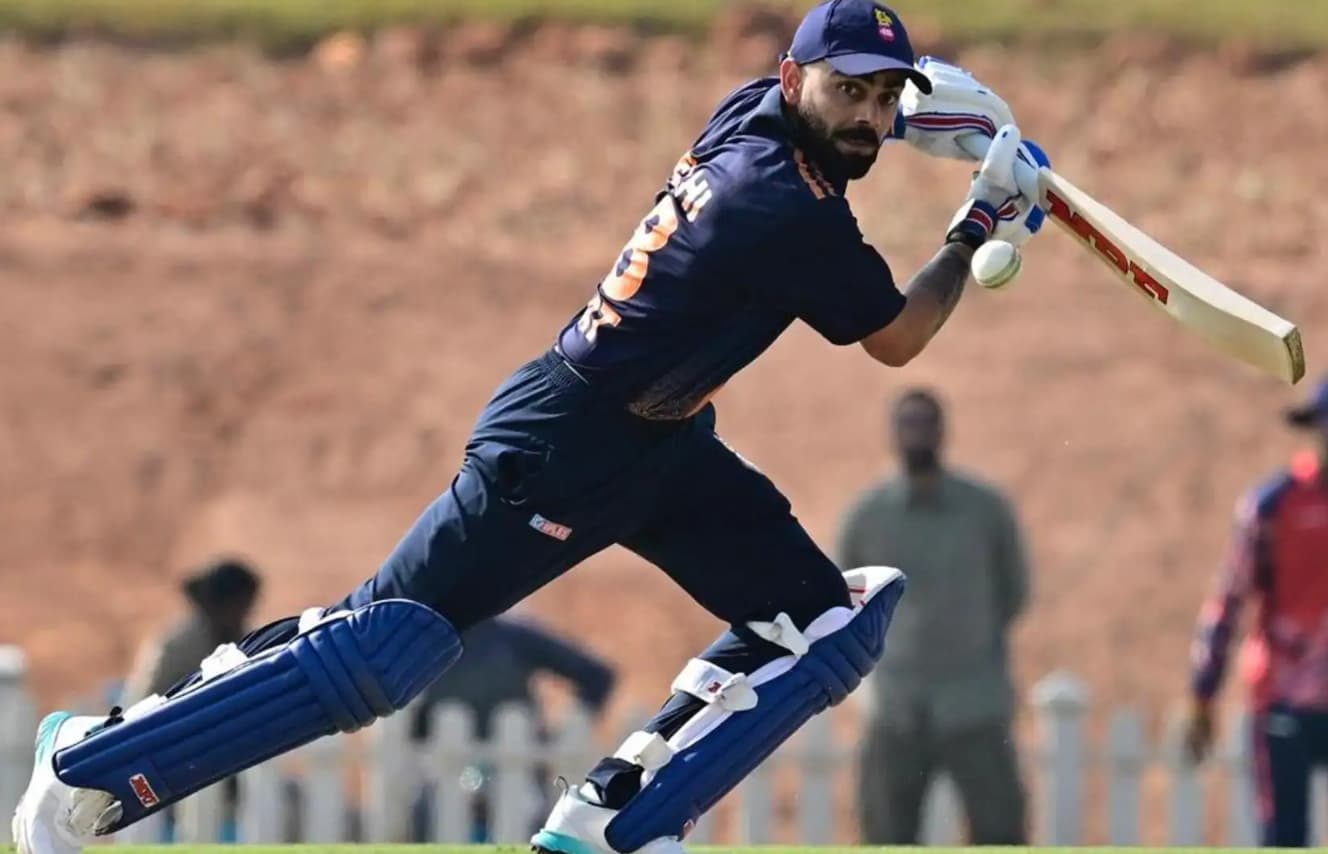
Virat Kohli Scores Century in Vijay Hazare Trophy 2025–26
Delhi’s chase against Andhra Pradesh required navigating a substantial target with limited wicket resources.
Early dismissals placed rebuilding responsibility on middle-order batters while maintaining chase viability.
Kohli entered during this critical phase, facing immediate pressure to stabilize without sacrificing required scoring rates.
The match context demanded tactical flexibility across different bowling phases. Middle-overs presented defensive field settings requiring strike rotation skills.
Death overs brought yorker-heavy attacks and wide-line strategies testing boundary-finding ability under pressure. He managed these transitions through shot selection adjustments matched to specific bowling plans.
Pressure moments appeared when required run rates climbed during tight overs. Partnership breaks threatened chase momentum, demanding immediate rebuilding without panic.
His response involved measured risk-taking aligned with field placements and bowling matchups rather than aggressive intent throughout the innings.
Virat Kohli Today Innings (VHT 2025–26)
| Runs | Balls | Fours | Sixes | Strike Rate |
|---|---|---|---|---|
| 131 | 101 | 14 | 3 | 129.70 |
Shot control manifested through boundary type distribution. Fourteen fours versus three sixes indicates ground-based scoring preference.
The four-to-six ratio reveals reliance on placement precision over power hitting. This approach reduces dismissal risk from mistimed aerial shots while maintaining boundary frequency.
Pace of scoring stayed consistent at 129.70 strike rate, balancing accumulation with acceleration requirements.
The rate exceeds run-a-ball without entering high-risk territory. He maintained momentum through singles and doubles between boundaries, ensuring scoring continuity across all bowling phases.
Risk management showed in shot selection and timing. Seventeen boundaries from 101 deliveries mean boundary attempts occurred selectively rather than continuously.
The remaining balls produced runs through rotation, indicating calculated batting where aggressive shots aligned with specific tactical opportunities.
Virat Kohli in Domestic List-A Cricket
Domestic List-A appearances became limited after India selected him for ODI duty in 2008. Within two seasons, international commitments expanded from occasional matches to year-round participation. This progression eliminated availability windows for state tournaments as bilateral series, ICC events, and training schedules consumed the cricket calendar.
Early India ODI selection impacted domestic exposure by creating scheduling conflicts. The BCCI structure prioritizes international cricket over domestic participation for established players. Once he secured regular ODI positions, domestic appearances stopped almost entirely. The Virat Kohli domestic matches centuries list, therefore, covers primarily his early career seasons before international cricket became his primary platform.
Virat Kohli’s Domestic List-A Record
| Category | Record |
|---|---|
| Domestic List-A Matches | Limited (mainly Vijay Hazare Trophy) |
| Domestic List-A Runs | 800+ for Delhi |
| Batting Average | 60+ |
| Domestic List-A Centuries | 5 |
| Key Tournament | Vijay Hazare Trophy |
Efficiency matters more than volume because limited sample sizes require different analytical approaches. His 60+ average demonstrates scoring consistency despite few opportunities. With small innings counts, conversion rates and scoring patterns provide better performance indicators than aggregate statistics. Each innings carries proportionally greater statistical weight when total appearances remain minimal.
Breakthrough Season: Vijay Hazare Trophy 2009
Kohli’s batting role for Delhi in 2009 centered on first-drop responsibilities. The team positioned him as the primary run accumulator following the openers. This role required adapting to varying match situations—rebuilding after early collapses or accelerating from stable platforms. His 534 runs across seven matches made him the tournament’s leading scorer.
Match situations during that season varied across different opponents and venues. Some matches required building defendable first-innings totals under pressure. Others involved chasing targets where required rates dictated tempo. He delivered centuries across these different tactical contexts, showing versatility beyond single-match-type specialization.
Repeated century-making patterns demonstrated sustained technical consistency. Scoring four hundreds in seven matches requires maintaining form across consecutive games while adapting to different bowling strategies. Each opposition studied his previous innings, making repeated success progressively more challenging.
Virat Kohli Domestic List-A Century List (Delhi Only)
| Season | Opponent | Runs | Tournament |
|---|---|---|---|
| 2009 | Jammu & Kashmir | 102 | Vijay Hazare Trophy |
| 2009 | Multiple opponents | 100+ | Vijay Hazare Trophy |
| 2009 | Multiple opponents | 100+ | Vijay Hazare Trophy |
| 2009 | Multiple opponents | 120+ | Vijay Hazare Trophy |
| 2025–26 | Andhra Pradesh | 100+ | Vijay Hazare Trophy |
The virat kohli list-a century list shows exclusive Delhi representation throughout his domestic career. Every century came while playing for his home state. No other team appears in his domestic century records, creating complete geographical concentration.
Delhi accounts for all centuries because it remained his only state affiliation during domestic availability periods. The state cricket structure provided his development pathway from junior levels through senior competitions. The virat kohli domestic centuries list splits distinctly into 2009 cluster and 2025–26 addition, separated by his international career phase.
2025–26 Comeback: Century After 15 Years
The 15-year domestic gap meant facing evolved bowling strategies and different player generations. Domestic cricket progressed significantly during this interval—new tactical approaches emerged, player skill levels advanced, match strategies modernized. His return required immediate adaptation without gradual adjustment periods that extended absence might typically demand.
Match pressure during the chase stemmed from target size and wicket situation. Delhi needed substantial runs with limited batting resources remaining. The circumstances demanded instant format comprehension and tactical execution under pressure, leaving minimal margin for errors or extended settling phases.
Familiarity with 50-over pacing transferred from extensive ODI experience. List-A cricket’s structural elements—fielding restrictions, bowling quotas, powerplay regulations—operate identically across competitive levels. His international experience provided automatic format understanding, eliminating adjustment requirements despite prolonged domestic absence.
Career List-A Records Snapshot
| Record Category | Details |
|---|---|
| Total List-A Centuries | 58 |
| Total List-A Runs | 16,000+ |
| Indian Rank | Second Indian after Sachin Tendulkar |
| Overall Batting Average | 57.34 |
| Best Among 16,000+ Run Scorers | Highest average |
| Domestic List-A Average (Delhi) | 60+ |
These statistics aggregate domestic and international List-A performances. The 58-century count combines both categories. The 16,000+ runs similarly incorporate all List-A cricket regardless of competition level. His 57.34 average represents sustained consistency across nearly two decades. The domestic average exceeding his international figure reflects sample size differences rather than performance variation.
Domestic List-A vs International ODI Centuries
The format separation reveals five domestic List-A centuries and 53 international ODI centuries. This distribution directly correlates with match availability. He played hundreds of ODI matches for India but minimal domestic List-A games after 2009. International centuries accumulated through year-round participation across bilateral series and ICC tournaments.
Domestic numbers remain lower due to opportunity constraints rather than ability differences. Once players establish international positions, domestic participation becomes exceptional. Cricket scheduling structures separate international and domestic competitions, creating participation exclusivity for established international players across most cricket boards globally.
Why Kohli Domestic List-A Centuries Matter?
His domestic centuries reveal important developmental elements:
Technical foundation establishment occurred through domestic century patterns in 2009. The repeated hundreds demonstrated established batting methods proving consistently effective across different state attacks during formative career years.
Match temperament formation happened through state-level competitive pressures. Scoring centuries while carrying team responsibilities under regional scrutiny built psychological resilience applicable to international cricket’s different pressure contexts.
Readiness for international cricket appeared in domestic success. His 2009 Vijay Hazare Trophy performances directly preceded rapid international progression, suggesting domestic achievements served as selection validation indicators for international assignments.
Conclusion:
The Virat Kohli List-A century list at the domestic level represents an achievement concentrated within limited availability windows. Five centuries across two career periods create unusual temporal distribution patterns. The 2009 breakthrough season and 2025–26 comeback bookend a 15-year gap consumed by international commitments.
Statistical interpretation requires acknowledging exposure limitations as fundamental context. His domestic record stopped accumulating after international establishment, creating early career snapshots rather than continuous documentation. Unlike players maintaining parallel domestic and international participation, his numbers represent isolated temporal segments.
The separation between domestic and international List-A statistics remains analytically essential. His 58 total centuries combine distinct competitive contexts demanding independent analysis. Five represent Delhi in domestic tournaments, while 53 came in international ODIs—separate categories requiring discrete statistical treatment.
His domestic century record appears complete at five unless future circumstances create additional participation opportunities. Career trajectory suggests further domestic appearances remain unlikely except under specific conditions. This statistical closure makes his domestic record a fixed dataset for analyzing pre-international development and validating skill retention through the 2025–26 comeback after an extended domestic format absence.
