Balls faced determine the primary duck classification in cricket scoring. A batter facing zero balls gets a diamond duck.
A batter facing one ball gets a golden duck. A batter facing two balls gets a silver duck. A batter facing three balls gets a bronze duck.
Scorecard notation shows balls faced in brackets after the zero. The notation 0(0) means zero balls faced.
The notation 0(1) means one ball faced. The notation 0(2) means two balls faced. The notation 0(3) means three balls faced. The notation 0(4) or higher means a regular duck.
Batting position creates additional duck classifications when combined with balls faced.
Openers at positions 1 and 2 have special duck types. A position 1 or 2 batter with 0(0) gets a titanium duck. A position 1 or 2 batter with 0(1) on the innings’ first ball gets a royal duck.
Openers have special duck classifications because their dismissals occur at innings start.
This timing affects team strategy and match momentum differently than middle-order ducks. Scoring manuals separate opener ducks from other position ducks for this reason.
Innings context matters for laughing duck classification. The last batter dismissed for zero receives this designation.
This applies to position 10 or 11 batters who end the innings. Their balls faced can be any number from 0(0) to 0(n).
Contents
- 1 Types of Ducks in Cricket
- 1.1 Quick Answer:
- 1.2 What is a Duck in Cricket?
- 1.3 Top 9 Ways Types Of Duck In Cricket
- 1.4 Types Of Duck In Cricket – Explained
- 1.5 Regular Duck
- 1.6 Golden Duck
- 1.7 Silver Duck
- 1.8 Bronze Duck
- 1.9 Diamond Duck
- 1.10 Titanium Duck
- 1.11 Royal Duck
- 1.12 Laughing Duck
- 1.13 Golden Goose
- 1.14 Records on Ducks in Cricket
- 1.15 Most Ducks in Test Cricket
- 1.16 Most Golden Ducks in ODIs
- 1.17 Most Golden Ducks in T20Is
- 1.18 Value of Duck Out Rule in Cricket
- 1.19 FAQs on Ducks in Cricket
- 1.20 Conclusion:
Types of Ducks in Cricket
Quick Answer:
Cricket features multiple duck classifications for zero-run dismissals. Most common are Regular Duck (out after 4+ balls), Golden Duck (out first ball), Silver Duck (out second ball), and Bronze Duck (out third ball). Specialized types include Diamond Duck (dismissed without facing a legal ball), Titanium Duck (opener out before facing), Royal Duck (opener out on innings’ first delivery), and King Pair (golden ducks in consecutive Test innings).
What is a Duck in Cricket?
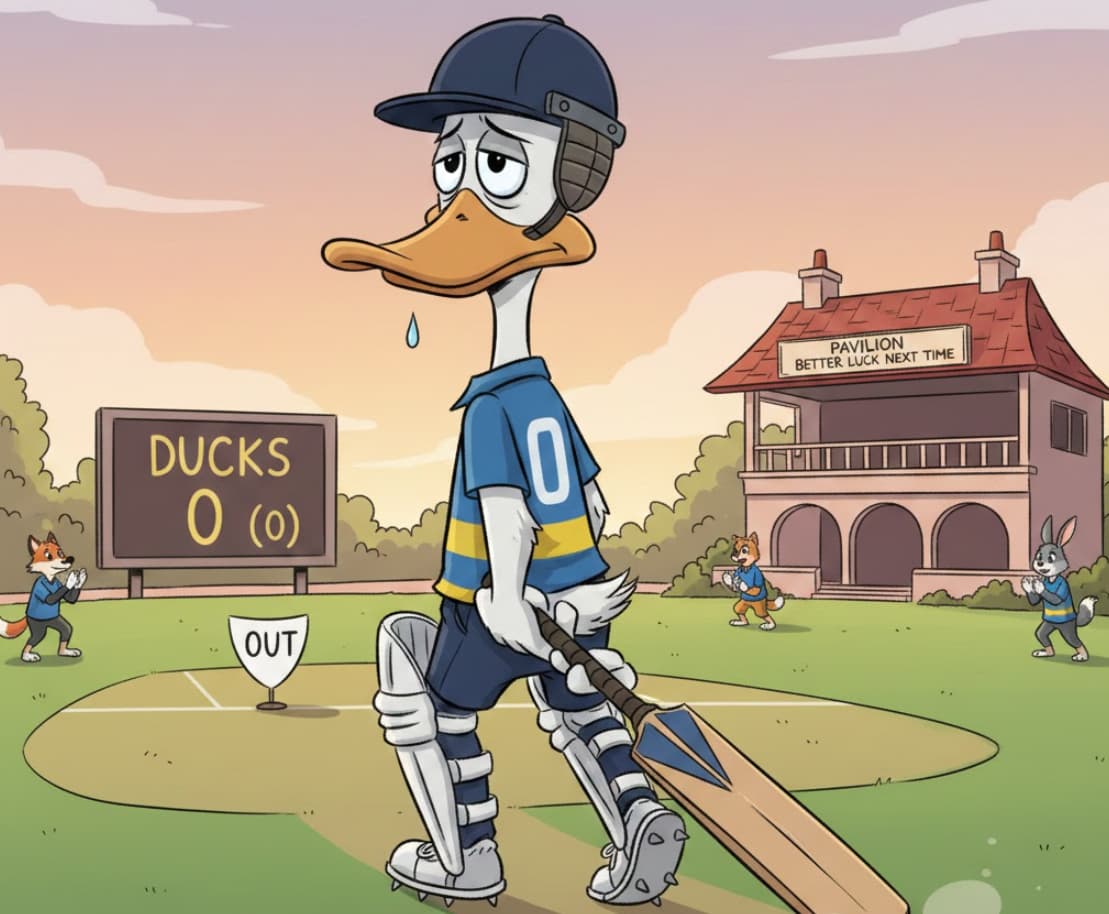
A duck is defined in cricket laws as a batter dismissed without scoring any runs.
Law 3 covers dismissals, which include bowled, caught, LBW, stumped, run out, and hit wicket.
All these dismissal methods qualify for duck classification when the score is zero.
Scorecard logic requires recording both runs scored and balls faced. The format is runs(balls) for each batter.
A duck appears as 0(n) where n equals the legal deliveries faced. Some scorecards show a simple 0 without brackets for unspecified ball counts.
Facing a ball means a legal delivery reaches the batter or passes within playing reach. Wide balls and no-balls are not legal deliveries.
A batter dismissed off a wide ball without facing legal deliveries gets 0(0) notation. A batter dismissed after one legal delivery gets 0(1) notation.
Duck classification applies to all innings in Test cricket, ODI cricket, and T20 cricket. First innings ducks and second innings ducks are recorded identically.
The balls faced and batting position determine classification regardless of the innings number.
Top 9 Ways Types Of Duck In Cricket
| Duck Type | Balls Faced | Batting Position | Innings Context | Rarity |
|---|---|---|---|---|
| Regular Duck | 4 or more | Any position | Any time in innings | Very common |
| Golden Duck | 1 | Any position | Any time in innings | Common |
| Silver Duck | 2 | Any position | Any time in innings | Uncommon |
| Bronze Duck | 3 | Any position | Any time in innings | Uncommon |
| Diamond Duck | 0 | Any position | Any time in innings | Rare |
| Titanium Duck | 0 | Position 1 or 2 only | Innings start only | Very rare |
| Royal Duck | 1 | Position 1 or 2 only | First ball of innings | Rare |
| Laughing Duck | Any number | Position 10 or 11 typically | Final wicket only | Common |
| Golden Goose | 1 | Any position | First dismissal of season | Very rare |
Types Of Duck In Cricket – Explained
Regular Duck
A regular duck is recorded when balls faced equal four or more. The scorecard shows 0(4), 0(5), 0(6), or any number above three. This classification applies to any batting position from opener to number 11.
Position does not affect regular duck classification. A position 1 batter with 0(7) gets a regular duck. A position 6 batter with 0(4) gets a regular duck. A position 11 batter with 0(15) gets a regular duck.
Golden Duck
A golden duck requires exactly one ball faced. The scorecard notation is 0(1). This applies when a batter faces their first legal delivery and gets dismissed without scoring.
Batting positions 3, 4, 5, 6, 7, 8, 9, 10, or 11 all get standard golden duck classification. Position 1 or 2 batters get a golden duck unless they face the innings’ very first ball, which creates a royal duck classification instead.
Silver Duck
A silver duck requires exactly two balls faced. The scorecard shows 0(2). The batter must face two legal deliveries before dismissal to qualify for this classification.
Position is irrelevant for the silver duck. A position 1 opener with 0(2) gets a silver duck. A position 8 batter with 0(2) gets a silver duck. The two-ball requirement is the only classification rule.
Bronze Duck
A bronze duck requires exactly three balls faced. The scorecard notation is 0(3). Three legal deliveries must be bowled to the batter before dismissal occurs.
All batting positions from 1 to 11 use bronze duck classification for 0(3) scores. Position 1 with 0(3) is bronze duck. Position 11 with 0(3) is bronze duck. No position-based exceptions exist.
Diamond Duck
A diamond duck requires zero balls faced. The scorecard shows 0(0). This occurs when a batter is dismissed without facing any legal delivery from the bowler.
Common scenarios include running out at the non-striker’s end while backing up. A position 3 batter runs out backing up, gets diamond duck. A position 9 batter stumped off a wide ball gets diamond duck. Position affects the titanium duck classification but not the standard diamond duck.
Titanium Duck
A titanium duck requires batting position 1 or 2 and zero balls faced. The scorecard shows 0(0) for an opener. This is a diamond duck specific to opening batters at innings start.
Position 1 batter runs out without facing, gets a titanium duck. Position 2 batter runs out without facing, gets a titanium duck. Position 3 batter runs out without facing gets regular diamond duck, not titanium duck.
Royal Duck
A royal duck requires position 1 or 2, one ball faced, and that ball being the innings’ first delivery. The scorecard shows 0(1) for the opener. This combines golden duck mechanics with innings-first-ball context.
Position 1, facing the first ball and getting dismissed, creates a royal duck. Position 2 cannot get the royal duck because position 1 always faces first.
If position 1 survives and position 2 faces the second ball and gets out, that is a golden duck, not a royal duck.
Laughing Duck
A laughing duck requires being the final wicket dismissed for zero. Balls faced can be 0(0), 0(1), 0(5), or any number. The classification depends on being the tenth wicket, not on balls faced.
Position 11 batters typically get laughing ducks when dismissed for zero as the final wicket. Position 10 can also get a laughing duck if position 11 is not out. Innings context determines this duck, not position number alone.
Golden Goose
A golden goose requires one ball faced and being the first dismissal of a new season. The scorecard shows 0(1). This classification adds season timing to the golden duck definition.
Any batting position from 1 to 11 can receive the golden goose designation. Position 1 with 0(1) on the season’s first dismissal is a golden goose. Position 7 with 0(1) on the season’s first dismissal is a golden goose.
Records on Ducks in Cricket
Most Ducks in Test Cricket
- Courtney Walsh (West Indies) — 43 ducks
- Chris Martin (New Zealand) — 36 ducks
- Glenn McGrath (Australia) — 35 ducks
- James Anderson (England) — 34 ducks
- Muttiah Muralitharan (Sri Lanka) — 33 ducks
Most Golden Ducks in ODIs
- Lasith Malinga (Sri Lanka) — 13 golden ducks
- Sanath Jayasuriya (Sri Lanka) — 11 golden ducks
- Shahid Afridi (Pakistan) — 10 golden ducks
- Muttiah Muralitharan (Sri Lanka) — 10 golden ducks
- Chaminda Vaas (Sri Lanka) — 9 golden ducks
Most Golden Ducks in T20Is
- Tillakaratne Dilshan (Sri Lanka) — 9 golden ducks
- Paul Stirling (Ireland) — 8 golden ducks
- Aaron Finch (Australia) — 8 golden ducks
- Rohit Sharma (India) — 7 golden ducks
- Quinton de Kock (South Africa) — 7 golden ducks
Value of Duck Out Rule in Cricket
Duck classification measures batting risk through balls-faced analysis. A batter with frequent 0(1) scores shows high early dismissal risk.
A batter with frequent 0(8) scores shows an inability to convert starts. Balls-faced data reveals different batting weaknesses.
Early dismissal ducks carry a different value than late dismissal ducks. A position 3 batter with 0(1) wastes less team time than 0(15).
A position 7 batter with 0(12) consumes more deliveries than 0(2). Ball count affects team strategy and run rate differently.
Psychological pressure varies by batting position and balls faced. Position 1 or 2 batters face new ball pressure.
Golden ducks and royal ducks reflect this pressure. Position 9, 10, 11 batters face batting skill pressure. Laughing ducks reflect lower technical ability expectations.
Duck statistics remain official because they quantify batting performance objectively. Scorecards record balls faced for every dismissal.
Duck classification uses this data to create performance categories. Statistical tracking requires standardized duck definitions across all matches.
FAQs on Ducks in Cricket
- What is the ducks name in cricket?
A duck means dismissal for zero runs. The term applies to any batter dismissed without scoring. Different types include golden duck, diamond duck, silver duck, bronze duck, royal duck, titanium duck, laughing duck, and golden goose.
- What is a titanium duck in cricket?
A titanium duck requires batting position 1 or 2 and zero balls faced. The scorecard shows 0(0) for an opener. This is a diamond duck specific to opening batters only.
- What are two ducks in cricket called?
Two consecutive ducks across separate innings are called a pair. Two golden ducks in both innings of a Test match are called a king pair. The scorecard shows 0(1) in the first innings and 0(1) in the second innings.
- What does 3 ducks in a row mean?
Three consecutive ducks mean dismissals for zero in three straight innings. No special term exists for this sequence. Scorecards record three separate 0(n) entries across different innings or matches.
- What is a diamond duck in cricket?
A diamond duck requires zero balls faced. The scorecard shows 0(0). This occurs through run out at the non-striker’s end or stumped off a wide ball before facing any legal delivery.
- Is number 69 banned in cricket?
No, jersey number 69 is not banned. Players can wear any number on their playing kit. No cricket law or ICC regulation prohibits specific jersey numbers.
- What are the 8 types of ducks in cricket?
The eight main types are regular duck, golden duck, silver duck, bronze duck, diamond duck, titanium duck, royal duck, and laughing duck. Each has specific ball-faced and position requirements.
- What is a jaffa in cricket?
A jaffa is an unplayable delivery. The term describes a perfect ball that cannot be defended or attacked. This is cricket slang, not an official scoring term.
- Which batsman has 0 ducks?
No batter with a substantial career has zero ducks. All batters are dismissed for zero at some point. Even top batters have multiple ducks across their careers.
- What is a royal duck in cricket?
A royal duck requires position 1 or 2, one ball faced, and that ball being the innings’ first delivery. The scorecard shows 0(1) for the opener on the first ball bowled.
- What is a diamond duck in IPL?
A diamond duck in IPL means zero balls faced before dismissal. The scorecard shows 0(0). The same rule applies as in other cricket formats.
- What is a laughing duck in cricket?
A laughing duck requires being dismissed as the final wicket for zero runs. Balls faced can be any number. The classification depends on being the tenth wicket out.
- What is a king duck in cricket?
King duck means golden ducks in both innings of a Test match. The scorecard shows 0(1) in the first innings and 0(1) in the second innings. This is also called a king pair.
- Who is known as Bombay duck in cricket?
Ajit Agarkar received the nickname Bombay Duck. This came from seven consecutive ducks during the 1999-2000 Australia tour. The nickname relates to his duck frequency during that period.
- What level is a diamond duck?
A diamond duck with 0(0) is rarer than a regular duck, a golden duck, a silver duck, and a bronze duck. The zero balls faced requirement makes this classification unusual across all batting positions.
- Who scored 36 runs in 1 over?
Yuvraj Singh scored 36 runs in one over against Stuart Broad in the 2007 T20 World Cup. He hit six consecutive sixes in that over.
- How many types of ducks are there?
Nine duck types exist in cricket terminology. These are regular duck, golden duck, silver duck, bronze duck, diamond duck, titanium duck, royal duck, laughing duck, and golden goose.
- What is howzat in cricket?
Howzat is an appeal asking the umpire for a dismissal decision. The term is short for “How is that?” Fielding teams use this when claiming wickets.
Conclusion:
Balls-faced logic creates the primary duck classification system. Zero balls equals diamond duck. One ball equals a golden duck.
Two balls equal a silver duck. Three balls equal a bronze duck. Four or more balls equals regular duck. This system applies uniformly to all batters.
Position-based understanding adds titanium duck and royal duck classifications. Position 1 or 2 with 0(0) creates a titanium duck.
Position 1 or 2 with 0(1) on the innings’ first ball creates a royal duck. Laughing duck depends on being the final wicket regardless of position number.
Common ducks like regular duck and golden duck occur frequently across all batting positions.
Rare ducks like the titanium duck and the diamond duck require specific circumstances of zero balls faced.
Royal duck requires specific timing as innings’ first ball.
Duck classification rules matter in scoring because they create standardized performance categories.
Scorers record balls faced for every dismissal. Duck types use this data to classify batting failures consistently.
This consistency enables accurate statistical tracking across all matches and formats.
Also Check:
